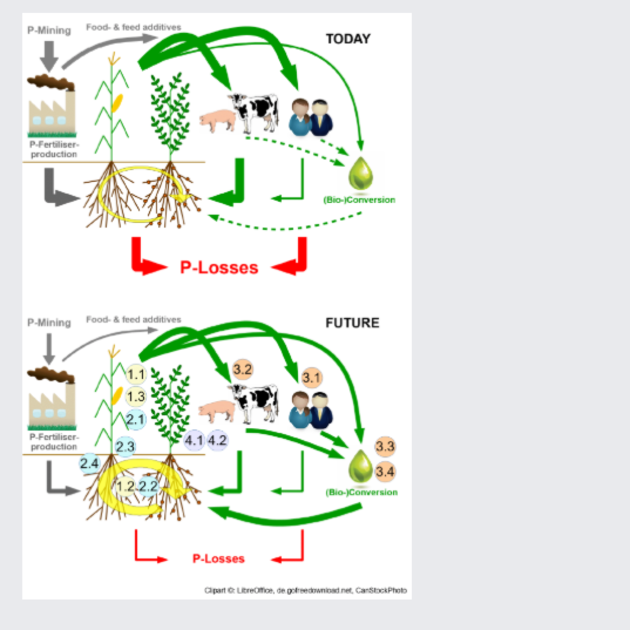
AMAIZE-P: Adaptation of maize-based food-feed-energy systesm to limited phosphate resources
Allocation of assimilated carbon to different tissues or organs is strongly influenced by nutrient availability. Especially phosphorus is a poorly available nutrient to plants due to fixation and extremely low diffusion rates of phosphates in the soil. Phosphate limitation generally enhances carbon allocation towards the root to produce a large root system. In addition, phosphate limitation stimulates the secretion of chelating agents such as citric acid and other carboxylates, or
the release of carbon to arbuscular mycorrhizal fungi in exchange for phosphate.
Thus, the uptake of phosphate from soils depends on sufficient carbon supply from the shoot to the root as well as on the carbon demand of other sink organs, such as the maize ear.
Potential topics for doctoral theses
Topic 1 (German): Establishing regulatory networks from large scale quantitative proteomic profiling in response to low phosphate availability
Topic 2 (German): Molecular basis of P use efficiency revealed from a comparative analysis of maize varieties with different P tolerance and carbon allocation properties
Topic 3 (German): From lab to field: Systematic validation of regulatory target genes in field experiments
Topic 1 (Chinese): Accumulation and allocation of starch in source and sink organs in maize under different P regimes
Topic 2 (Chinese): Spatiotemporal accumulation of carbohydrates and regulation of carbon metabolism in the maize ear under different P regimes
Topic 3 (Chinese): Regulation of carbohydrate transport by ZmPHR in the maize ear under P limitation